Monday, June 6, 2011

When Lord Kelvin Was Napping


I woke up to find more water column. I was under the impression that at 0400 I would awake to watch the connectors being plugged in and the puzzle pieces being put together.  Jason had descended the evening prior and would have had plenty of bottom time by then.  Apparently, though, as I was sleeping a puzzle pieces – a piece of twine – got sucked into one of Jason’s thrusters and he had to be brought up, patched up, and redeployed. I arrived on the scene just in time to soak in a couple hours of the water column as he descended and a little bit of “Jason on bottom.”

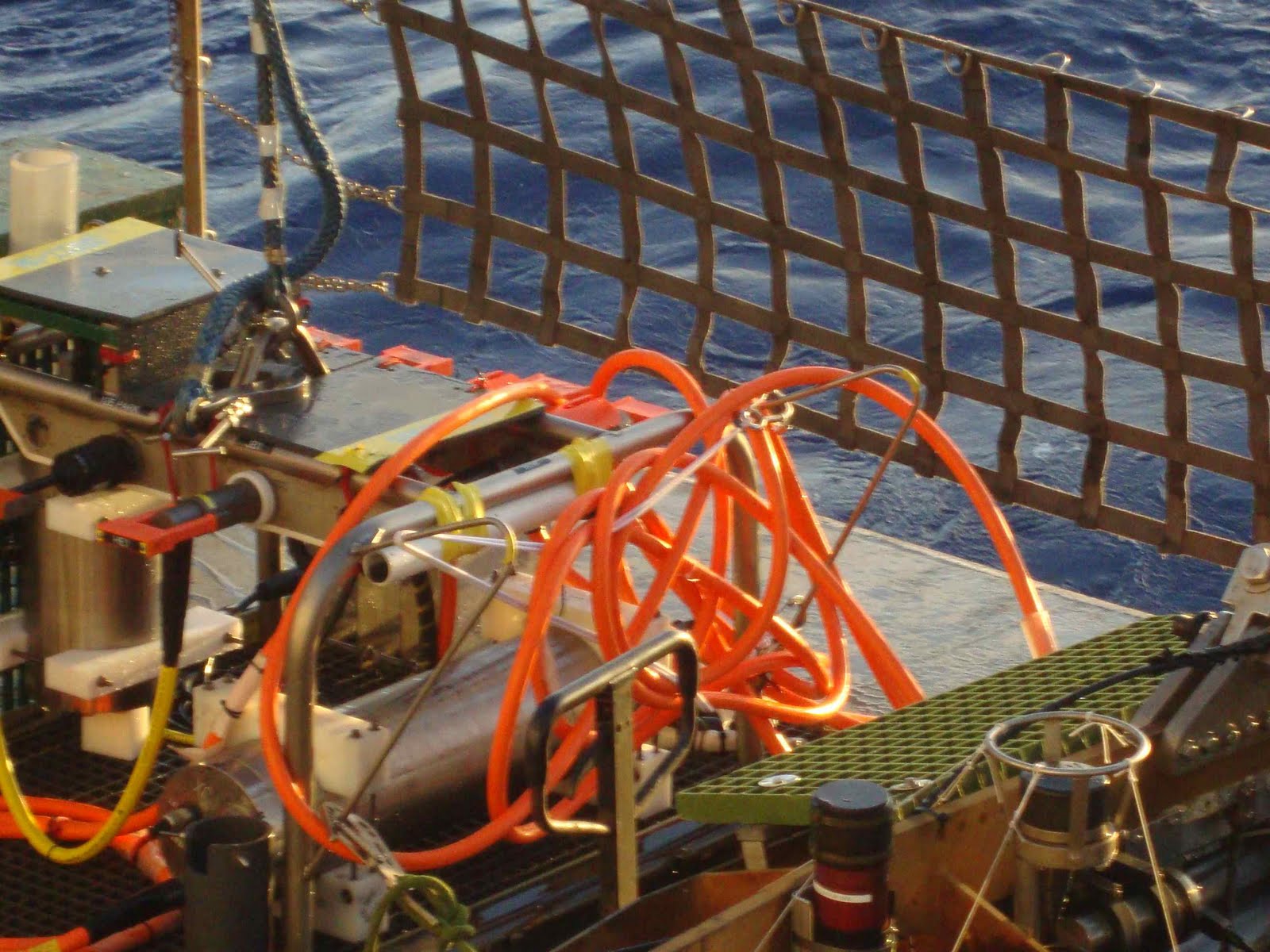
The rest of the day was slow.  The back deck is so lonely now that all the equipment is at the bottom of the ocean.   They were all having an exclusive get together down there to which only those who can withstand 5000 decibars of pressure are invited. Jason was the guest of honor, Medea came as a member of the press, and the rest of us got to watch the celebrities live on Channel Jason.  We watched cables being un-bungeed from the AMM and strung across the mud to the observatory. The same for the camera tripod and the TAAM mooring.

While we sat and observed Jason go to work, the conversation drifted to physics in the ocean.  Roger pointed out to me the places in which Newtonian physics plays clear and important roles in the dynamics of the ocean and atmosphere. Though oceanography is fairly new to me, Newtonian mechanics make things clearer to me in all settings. You can see it in propagation of El Nino effects across the Pacific in the form of Kelvin waves. You can see it in white caps and waves forming at the ocean’s surface due to the wind’s drag– manifesting the Kelvin-Helmholtz instability – and how that affects the development of hurricanes. You can see it in the rotation of the earth resulting in the Coriolis Effect. I addition to learning about Roger’s work and how simple physics concepts fit into complicated questions like ‘how does the ocean affect the atmosphere?’ I learned that Lord Kelvin, as Roger put it, is ubiquitous. From the 0 K air-conditioned control van, to Kelvin waves to Kelvin-Helmhotz instability, Lord Kelvin pops up everywhere on this ship.

In the afternoon, when my personal physics lecture was over and Lord Kelvin was napping, I popped into the Jason van for my 1600 to 2000 Jason watch.  When I took over the event logger, Jason was returning to my lounge chair to begin unraveling the second neon green cable and stringing it out to the observatory.  Before we did so, we decided to scan the mooring up and down because opportunities to examine moorings while they’re in the water are few.  At about 5 m up, the cameras zoomed in on the inductive modem to find that the cable intended to connect it to the rest of the observatory had come unplugged.  Unfortunately this connector is not one that can be reconnected under water.  This means that the data from the thermistor array will not be available in real time to Makaha. Luckily, though, the instruments are already programmed to collect data autonomously, which can be collected in a few years when the mooring is recovered.

After watch, with no recliner from which to observe the stars, I ‘re-racked’ in preparation for 0400 to arrive again. 

Sunday, June 5, 2011

Perhaps a Game of Tug of War Is All the Cable Needs


I woke up in a remarkably still bunk. I came out to the staging bay to find it bustling with hard hats and life vests. Behind them was a noticeable dearth of white caps and sinusoidal forms. Overnight, the squall had apparently found somebody else to harass and left us to deploy the TAAM in relative stability. Everyone had leapt at the opportunity of calmness and I was already late though I arrived at the party ten minutes early. Someone had pressed play on the scene from yesterday and we were off.

My official title in this operation was “Instrument Stager.” This means that I helped Cammy prepare the instruments to hand to Jefrey and Dave, the assemblers.  My box of instrument parts and I stood off to the starboard side of the A-frame trying to maintain the balance between close enough to hand something to Dave but far enough away to not trip Dave or get too close to heavy moving objects and wires under tension.

The first to go swimming was the anchor, followed shortly by the acoustic release and the inductive modem. These parts hung over the stern from the end of the jacketed wire rope, which was unspooling from the winch.  Simultaneously, a neon green communications cable that runs parallel to the black wire but carries no load was unspooling. Once the anchor hung ten meters below deck, the first yellow duct tape marker appeared on the black wire. This was the first of ten instrument markers that Dave, Jefrey, Nicholas and I attached to the wire two weeks earlier at snug harbor.  When the marker reached waist height, the winch was stopped.  Cammy handed Jefrey the thermistor and I handed Dave the clamps. Dave and Jefrey stood at the very edge of the back deck bolting the clamp to instrument thus sandwiching the jacketed wire rope. A cable spacer was then attached on either side of the instrument to keep the black and the neon green cables together but untangled.  The wire was then lowered another 10 m to the next instrument marker and the pattern continues through 30 m, 50 m, 100 m, all the way up to 200 m where the thermistor array ends. Then came the acoustic modem, followed shortly by 5 lengths of chain hosting three glass balls each. These fifteen glass balls in yellow casing are the source of buoyancy for the mooring as well as a thing of beauty hanging from the A-frame. Unwieldy on deck and quite heavy, once they are suspended in the air they waver and spin like plump yellow weather vanes against a blue sky.  In order to attach them, the weight of the anchor had to be transferred to A-frame momentarily while the glass balls’ chain was shackled and hoisted up to carry the load.  The cherry on top of the mooring was the second acoustic release that was to be triggered once the mooring was within 100 m of the seafloor.  With the cherry shackled in, the whole mooring was lowered through the water column over 4.7 km, giving us a brief repose in which to eat. The instruments indeed ended up center stage, so I feel my title earned.

At 1100, the anchor was approaching the bottom so it was time to prepare the deck box that transmits the acoustic signal to the releases. We waited for the green light after setting the hydrophones to the right frequency and uncoiling some particularly stubborn cables – at this point I am specially trained in taming cables so not even a knotted hydrophone cable can make me blink. The ship navigated the mooring to the correct position and the winch adjusted to the right depth then it was time to release.  Lowering the hydrophones overboard, we sent a loud zing through the water hoping to feel the decreased tension on the wire in response to the release. The wire remained tense. A second and third zing went travelling down. An enthusiast fourth and fifth were tried and somewhere between the sixth and seventh the release finally got the picture and let go. The anchor went barreling down to the seafloor taking with it the thermistor array to the chagrin of the yellow balloons.

The wire, now with just the release on the end, took another couple hours to come back up.  Once it got within 100 m of the surface the tension on the wire was not sufficient to wrap back on the winch properly. The solution to this problem involved no fiber optic cables or batter packs, no modems or thermistors, no computer code in Matlab or Dreamweaver, but simple, Newtonian physics. Most of the muscle on the ship grabbed a pair of gloves and pulled as hard as they could on the wire as it pulled back. A string of ten people on the quarterdeck playing tug of war with the winch provided tension enough to spool on the wire. The ten people rotated through until almost everyone on the ship had rusty brown streaks on their hands. I maintain that I could not take part because I couldn’t find any gloves. Feel free to believe me.

Before the TAAM mooring deployment was even finished, the observatory deployment began. The observatory was wheeled out to center stage where it underwent some last minute lashings and documentation. All the handles that Jason was going to have to pull to release the bungees and remove the ADCPs’ hard hats were inspected by the Jason team.  Just in time for pizza dinner, Jason, Medea and the observatory jumped in. They headed through the water column with the last piece of the puzzle in hand. Most of the puzzle is already laid out on the seafloor – the AMM, the camera, the J-box, and the TAAM mooring – and we’re all hoping that that one edge piece that’s always hiding under the corner of the rug decides to appear on the table top tomorrow.

Saturday, June 4, 2011

Two Parts Worried Scientists, One Part Forced Idle Time, Bake All Afternoon on the Quarterdeck

During my morning Jason watch, I caught the last 30 minutes and 13th rock grab of the geology dive and the entirety of the water column. The dive site was close enough to Oahu that we could see a smattering of lights on the horizon so the water column was quite short – only 1500 m.  Once Jason was on deck, and “Jason on deck” had been properly logged, it was ‘re-racking’ time – that’s Jason team talk for going back to bed.  On the way back to my rack, I took a detour to the bow where the sea and the sky yawned in greeting to the sun.

Noon was the scheduled time for the TAAM deployment so we had to move Medea out of the way and swing the anchor back to center. Once there, Jefrey began assembling the string of chains, cables, shackles, and everything in between. Just above the anchor he attached the acoustic release that will be triggered to open when the mooring is recovered.  Cammy and I stood by with zip ties in hand.

Though all the equipment was ready for deployment, the waves did not appear to be. The swell we experienced on Wednesday that sent us south for our geology intermission had not subsided by much. While deploying a mooring, the seas have to be particularly calm because the assemblers on the quarterdeck spend a lot of time on the edge handling equipment.  In addition to human safety, the equipment’s safety must be considered.   In order to attach the inductive modem above the release, the anchor must be lowered over the stern by a few meters and held there until the connections are made. When the seas are rough, this leaves the anchor vulnerable to dangling above the surface where it can swing more violently.  This danger was the main reason for stalling the mooring deployment on the quarterdeck.

All afternoon, everyone was hoping that the weather would improve and that the taunting grey squall would pass within an hour or so. Half the ship’s company huddled around the quarterdeck, hard hats and life vests at the ready.  Several worried scientists and involuntary idle time is a recipe for nit picking.  The huddle focused its attention around the anchor, pointing at this and poking that.  Uncertainty about things that seemed to have been certain just yesterday sloshed around the huddle with the heave of the ship.  Brows furrowed down over squinting eyes, idle hands rubbed chins, arms folded across life vests. 

Though the squall never stopped taunting, the nit picking did come to a conclusion. To avoid the sticky situation of attaching the inductive modem with the anchor swinging, the huddle devised a plan.  They attached the inductive modem while the anchor was still on deck in a way that left just enough clearance under the A-frame to lift the string of modem, release and anchor. We were set for the day ahead when the weather would hopefully be better behaved.

Worried scientists and idle time struck again later that evening when the anchor sat in the spotlight on the back deck. No one looks good under florescent lighting.  The anchor’s tiny flaws were illuminated and busy hands tended to them. Namely, the bungee cords holding the neon green cable on the spools were overstretched and I employed my newfound knot skills to make new ones.

When worried scientist went to bed, I took my last chance to recline in the spool of the anchor. A few stars made it through the cloud cover. The ship hummed and jolted as the waves slapped its underbelly like a washing machine with a pair of sneakers on spin cycle inside. Within a few minutes the clouds drizzled down droplets, which, as a Seattleite, I’m programmed to find refreshing.  Given a few more minutes, the clouds supplied something I could only find inconvenient. I let my recliner enjoy the Hawaiian blessing alone as I dried off and nodded off.

Friday, June 3, 2011

Who Needs a Hard Hat When You've Got a Crown?

Matt the birthday boy, also known as the ring leader of the Jason circus or the Jason Expedition Leader, deploys Jason while sporting his birthday headgear.


Thursday, June 2, 2011

Swinging Anchors and Inspecting Gadgets

With creative influence from our Backstreet Boys a cappella, Dave and I transformed these ordinary wing nuts securing battery packs in the ADCP’s into Bumblebee wing nuts with a few swipes from the sharpie. 


The dripping J-box in all its glory is given a royal welcome back to the quarter after a valiant attempt to connect to the cable termination. 


Jason’s underwater coiling job remains intact after being dragged through 5 km of the water column.


Tired of supplying the glorious lighting for these photos, the sun sets.


During its spa treatment, the titanium casing that protects the repeater and the fiber optic cable junction is carefully massaged open.


Everyone wanted a peek inside.


Inspector Gadget examines the surface of the cables through the microscope and determines that one of them could use a little attention.


Scott exfoliated the fiber’s surface by drawing figure eights on a piece of very fine sand paper.


Inspector Gadget finds that, after a little spa treatment, his gadgets are in order.  


The voltmeter is brought out to make sure that the power is, indeed, on.


Using red light and a dentist’s mirror, Inspector Gadget checks for the red light scattering from the fiber optic cables to make sure that the cables are transmitting light.


Festive colored fiberglass and lashings spruce up the anchor frame.


The Aloha Mars Mooring (AMM) Node gets prepped for its plunge.


It’s hauled up --


-- and tossed away.


The sun sets in Jason’s armpit.


Several people are required to tend tag lines to ensure that the anchor doesn’t dive into the sea as it is moved to the center of the quarterdeck.


Dave and Vic restrain the green behemoth from barreling into back deck equipment.


Sedated and strapped down to the deck, the anchor awaits its morning deployment. My reclining real estate now has seaside status. 


Morning breaks, and a rainbow with it, over the anchor. Unfortunately this morning brought 30-knot gusts and high swell so the anchor will have to wait another day.


Instead of deploying the TAAM mooring, we head to Ka’ena Ridge to fill in some paint strokes on the bathymetry survey. We pass by the point in 80 m of water –close enough to see the beach.  From the bridge, Cammy gives me a binocular tour of the west side of Oahu and we watch the bow in hopes that some dolphins might catch our waves.   While at the bridge, we also spend some time pushing buttons and asking questions about rudders, radar, Doppler and bow thrusters.  I even steer the ship for a minute. I hold the wheel – such a small wheel for such a chubby ship – and obey rudder angle commands until we reach the survey line, where autopilot takes over for me.  Could someone please fish out that bucket list I tossed overboard? I have something I’d like to cross off it.


The conditions are much calmer south of the ridge and Jason is allowed to jump in for a swim.  He dives to the bottom and collects rocks for the geologist. This dive was much closer to shore on a ridge that is believed to be an old section of Waianae.  The geologists can use the rock samples from this dive to compare with those from Ka’ena Ridge to determine if Ka’ena is the same as Waianae or different. 

Wednesday, June 1, 2011

The Spool of an Anchor is a Lovely Place to Recline


As predicted, 0400 came early than I’d hoped and I stumbled my way to the Jason van for another healthy dose of the water column.  Warm tea and a blanket were working against me so I fought to stay awake with doodling and periodic strolls to watch the development of the sunrise – from darkness with a few stars visible through the bright-as-day deck lights, to nautical twilight seeping up from the horizon, to civil twilight bright enough to see the waves, to the inching of the orange sun away from the sea, in no mood to rush the day.  At 0800 there was no use in fighting the drowsiness any longer and after breakfast I returned to bed.

When I awoke I learned that the reconfiguration of the J-box was not successful in getting a stronger optical signal to Makaha. As with before, the power was coming through just fine.  From here, the thought is that the problem may lie in the configuration of the repeaters on the seafloor between Makaha and Station Aloha.  There are over 200 possible configurations for that series of repeaters so the folks at the cable station are working their way through as many as they can.

In the afternoon, it was the anchor’s turn for a little affection. At the end of each of the neon green cables wrapped around the anchor are the same fragile connectors found throughout the equipment. They had been resting in holsters, but to protect them long term at the bottom of the ocean we installed the female end of the connector for a better seal. Lashing the fiberglass grid, on which the connector was mounted, to the anchor frame was my and John’s task. Similar to the macramé of my first day on the ship but with an improved knot-tying repertoire, I wrapped red twine this way and that until my hands were tired and stained with red dye.  That fiberglass grid has no chance of escape.

While wrapped up in lashings on the quarterdeck, I hadn’t noticed the sudden absence of normal commotion.   It wasn’t until someone said to me, “So the meeting’s already over?” that I realized there had been a meeting. I made it to the conference room in time for the last 5 minutes of it but I was assured that the first 25 minutes were too boring to merit relaying.

After dinner, it was the AMM node’s time to plunge. I watched the operation while reclining inside the spool of the anchor.  With some last minute adjustments – adding holsters for the USBL and Homer beacons that will be used to find the runaway node on the seafloor – the orange hulk was lowered into the water and released.  Within ten minutes, the beacons told us it was plowing at over 100m/min towards the seafloor.

With the bird perch out of the way, it was time to move the anchor to ready position for the Thermistor Array/Acoustic Modem (TAAM) mooring deployment scheduled for the next morning.  I tried to convince the crane operator that it would be just fine if I stayed in the spool while he swung the anchor under the A-frame but he was not so sure. The rest of the back deck was decorated in preparation for the deployment including laying out the strings of glass balls and rearranging the furniture to leave more room for dancing, I mean deploying. 

Fiber Optic Facials

Yesterday’s dive intended to send a test signal from Jason’s bellybutton to Makaha was cut short by a decision to remain on the safe side. Though the electronics from the umbilical cord were all wired through the connector in front of Jason, there was a worry that the connector itself was not suitably prepared to make the connection.  The connectors used throughout the observatory, J-box and termination frame are designed to be able to connect electronics underwater by gates and an oil-filled chamber. If the connector was not properly filled with oil, then seawater may be able to weasel its way in. The incompatibility between water and electronic equipment could have damaged the cable termination – a problem which would be bigger than any we’ve yet to face. Proceeding with caution, it was decided not use the bellybutton just bring the J-box back up for another period of pampering.

As with tasks in the past, what sounded like a simple motion – J-box up – sprouted difficulties left and right.  Firstly, Jason needed to coil up the cable that had extended from the J-box to the termination frame and place it securely on the J-box frame. We all watched from the lab television as Scott, Jason’s puppeteer on watch, coaxed the stiff orange cable into figure eights.  It was like watching Jason try to line up her kindergartners after recess. Each loop was constantly avoiding Jason’s grip and once he did get control of them, he had to keep a hand on them an all times or they’d duck under his arms and escape. Once he had the kindergartners remarkably well behaved, Scott had to strap them in with bungees attached to the frame by carabineers.   As you could imagine, the kindergartners wanted none of that. Difficulties ensued with carabineers clipping themselves where they’re not suppose to and handles breaking until the biggest battle of the watch: closing the shackle. Jason has no problem unscrewing a shackle with the extended handle. Perfectly lining the bolt up with the shackle’s holes is a different story that took about 20 minutes to tell.  As with Jason’s successes grabbing rocks, his fans in the lab cheered when the winding bolt came out the other side.

While Jason and the J-box were on their way up, there was work to be done in the staging bay to prepare for the AMM, or the orange bird perch, deployment late the next evening.  The weights, which will assist the AMM in its free fall to almost 5000 m, were at risk of harming the oxygen sensors mounted above them when Jason removed their bungees. To give a safe distance between ultra sensitive sensors and insensate metal hulks, Cammy, Jefrey and I relocated the instruments a foot higher. After unscrewing and retightening of bolts, clipping and re-zipping of ties and a bit of pampering, the bird perch is ready to take the plunge.

Jason just missed dinner, arriving on deck at 0700 or so.  Now it was the J-box’s turn for a bit of pampering. The treatment began with a freshwater bath – lemon and cucumber scented, of course, – followed by a towel pat down.  Then one of the metal cylinders resting on the bottom of the frame was carefully unbolted and slid open to reveal the colorful cables and foreign shapes that make up the fiber optic communications junction.  For a while, we all stood peering over Bruce’s shoulder as Bruce peered into the dark tunnel. Over the course of the night, this mysterious tunnel of wires became clearer to me but I will not be accepting questions at this time for my comprehension hangs by delicate strings.  Any prolonged pondering many detach me entirely.

What needed to be done was check the quality of the fiber optic cables in the tunnel and then reconfigure the cables.  For the first task, Scott looked at the end of the cable through a microscope shaped like a hiking flask.  The first cable looked fine, he said. The second showed signs of minor damage, which they let me look at through the microscope.  The fiber in the cable that communicates signal is no wider than a human hair so in the microscope I saw a thick exterior surrounding a tiny dark circle with streak marks across the screen -- scratches or residue to be removed.  To continue the spa treatment was a fiber optic facial. Scott brought out a sheet of very fine sand paper and drew figure eights on it with the cable tip. He repeated this exfoliation with three other sheets until both he and Bruce seemed satisfied with the result.

With the facial complete, the cables were reconnected to new pins. There are six pins in the tunnel from which to choose because the repeater on the J-box has the capability to send signals through six cables. The AT&T cable that extends from Station Aloha to Makaha has the capability to transmit on only four, narrowing down the pin choice in the tunnel by two.  This leaves two cables – one to receive and one to transmit – and four pins forming twelve possible configurations of how to connect the cables. Two have already been tried by the first and second J-box installments. The pin configuration chosen this time is the same one that had been successful in the hydrophone installation in 2007. 

At the same time that I was glued to Bruce’s shoulder watching him test the loss of attenuators and wipe the surface of cables, Grant and Roger were preparing Jason’s bellybutton for testing. They dissected the whole connector and laid out each part on the bench, looking for which pockets contained oil and which contained water. I was too sleepy to wait up for the tests once they closed back up the connector but I knew that I would find out soon – too soon as 0400 was approaching and my sleep window narrowing.